
Tips for developing AI literacy
The joys and frustrations of learning a new language

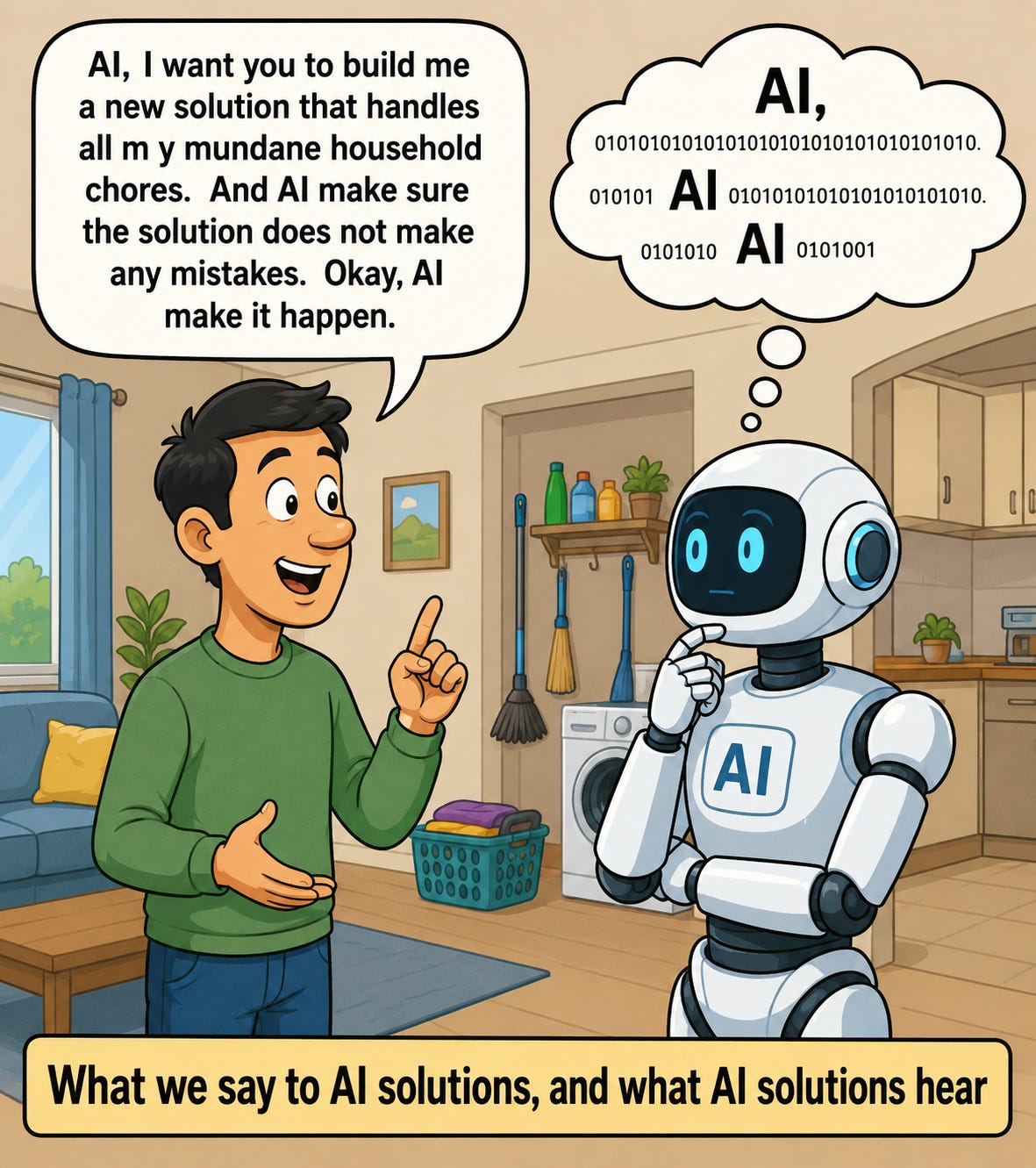
Cartoon inspired by Gary Larson
The term AI literacy has become increasingly popular in the talent management world. Companies want to build AI literate workforces and hire candidates who possess AI literacy. But what is AI literacy and how do we develop it?
AI literacy reflects one’s skill using AI powered solutions to achieve meaningful goals. It can be likened to language fluency in the sense it combines factual knowledge with creative skill. Like learning a language, it is also something you can only master through immersion. It would be hard to learn to speak French fluently without living in a French speaking part of the world. Similarly, it is impossible to become AI literate without spending considerable time using AI solutions to solve meaningful problems.
The following are a few tips from my own journey developing AI literacy. Offered in the hope they may provide a source of comfort or inspiration for those of you, who like me, might find this stuff a bit overwhelming and occasionally frustrating.
A little preparation is valuable but a lot of preparation generates diminishing returns. Developing AI literacy is like learning a language in the sense that it is useful to understand underlying structures that define how it works. Knowing something about the grammatical structure of a language makes it easier to grasp how that language is similar or different from other languages you might already know. The same is true for AI in terms of understanding things that govern how AI works related to machine learning, ontologies, and data structures. But the value of learning these things quickly diminishes compared to the value one gains from immersing yourself in the use of AI.
Get used to being confused. I have worked with AI solutions since my days as an undergraduate student learning recursive machine learning algorithms. Despite being around AI methods for decades, I readily admit to not fully understanding how it works at a detailed level. Just as you do not need to know every word in the dictionary to speak a language effectively, you do not need to know everything about AI to use it at an advanced level. This is one of the things that makes AI so useful. Unlike deterministic computer programming languages that required fairly detailed knowledge to use effectively, AI programming allows people to create practical software applications without understanding how they actually work.
AI solutions are designed to help you but you need to ask them for help. The companies building AI solutions generate revenue based on how often their solutions are used. Consequently, they put a lot of thought into designing solutions that support users in getting value from their tools. If you want to do something with an AI solution but aren’t sure how to do it, then ask the solution to coach you through the process. You might even ask the AI solution if it is able to build what you want to create. But keep in mind the solutions are designed to encourage you to keep using them. Their answers tend to be overly optimistic in terms of their capabilities as an AI solution and your skills as an AI user.
Use more than one AI solution. There are substantial differences in the underlying design and data used by the major AI solution providers. If you ask two solutions the same question you will get different answers, and sometimes they can be significantly different. It is valuable to use one solution as a source of second opinions to evaluate what you are building with another solution. You may also find that one solution is more adept at doing what you want to do than another, depending on what it is you want it to do. Each solution I use has its own particular strengths. How many solutions you use will depend in part on how much money you want to spend on tokens and licenses. But I recommend having at least two solutions you use on a regular basis.
Maintain a healthy skepticism. It is bad to anthropomorphize AI solutions for many reasons, yet it is almost impossible not to think of them as being akin to a work colleague, employee or consultant. However, remember AI solutions are just complex pattern recognition algorithms combined with masses of digitalized data. They have no sense of moral obligation about whether what they are doing is helpful or harmful. Even if they act like they care, they cannot actually care. What you do with AI is entirely your responsibility. The more important the task assigned to an AI solution, the more important it is to critically review the outcomes it produces. My own experiences with AI have led me to think of it as an enthusiastic and wildly overconfident consultant. It is rare for an AI solution to say, “you probably do not want to use me for this task because you might not like the outcome”. Unfortunately, you may have to burn a lot of tokens before reaching that conclusion yourself.
You learn the most when it doesn’t work the first time. It is amazing how easy it is to get AI to do things you want. But increasing your AI literacy means learning how to use AI in more powerful and unique ways. Just like anything else in life, if you want to get better at using AI you need to use to in ways that force you out of your comfort zone. Using AI for tasks that require considerable mental effort, time, and probably a lot of trial and error. AI literacy is not about learning what AI can do, it is about learning what you can do with AI. This means learning how to overcome problems that arise when AI does not do what you want the first time you ask it to.
My journey developing AI literacy reminds me of my experiences learning a foreign language. It is about figuring out how to communicate my goals and intentions to something that does not think the same way I do. The more time I spend doing it, the more fluent I become provided I challenge myself to engage in more complex conversations focused on increasingly sophisticated topics. At the same time, I have to keep in mind it may not interpret the meaning of my words the same way I do. Which is why I need to remain cautious when asking it do something that could create serious problems if it is done the wrong way.