
Breaking the Applicant Funnel
Fundamentally rethinking hiring process design

The nature of the labor market has changed significantly over the past 25 years. But the fundamental design of most hiring methods is the same as it was when recruiting transitioned to the internet around the turn of the century. A talent acquisition leader from 2005 would readily recognize the steps of defining job requisitions, posting jobs, gathering applicants, screening qualifications, assessing skills, evaluating competencies, extending job offers, and onboarding employees. These traditional hiring processes are often described using the analogy of “applicant funnels” where unfiltered candidates are fed into the top and run through a series of selection steps ultimately leading to a hire.
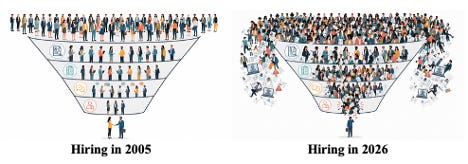
Candidates are the most important part of hiring. Yet they are treated more like commodities than people in the applicant funnel model, as reflected in phrases such as “filling candidate pipelines with higher applicant volumes”. At each step in the funnel candidates are told what they have to do to get past the next hurdle often with little explanation of why they have to do it. They are frequently left in the dark about their performance on screening exercises, the overall status of their application, when they are likely to hear from the company, and if they have a realistic likelihood of receiving a job offer. They rarely receive constructive information explaining why they did not get hired. Instead of feeling like a partnership between companies who need people and people who need jobs, the hiring process feels like an examination where candidates must prove themselves worthy of employment.
The applicant funnel is breaking
The traditional applicant funnel model of hiring has never worked that well from a candidate perspective. We are now reaching a point where companies can no longer ignore its inherent shortcomings. The applicant funnel methodology is beginning to fail for companies and candidates alike because of the following factors:
Applicant volumes clogging the funnel. The advent of AI tools enables candidates to apply to jobs with little to no effort. As a result, company hiring funnels are being overwhelmed by applications. It is not uncommon for companies to receive over 1,000 applications for a single role. This makes it difficult for companies to find the best candidates. It also makes it difficult for the best candidates to get noticed and find a job.
Susceptibility to candidate fraud. Applicants are using AI solutions to pass job screening and selection tests by exaggerating their skills, experience, and interests. Even more troubling, criminal organizations are using AI to create false candidates so they can steal company secrets or financial resources. Increasing use of automated candidate screening in response to applicant volumes clogging applicant funnels is likely to further increase candidate fraud. Job seekers may feel the only way to get through company screening methods is to falsify their application information, and standardizing selection processes allows criminals to systematically develop ways to get around hiring tests and screens.
Rewarding quality of candidate vs quality of hire. The majority of hiring technology solutions use data to predict people’s potential to be hired into the job. They do not use data to predict whether people are successful after they are hired. For example, many companies use structured internet search tools to identify candidates who are likely to do well in interviews. But there is big difference between being a good interviewer (aka, quality of candidate) and being a good employee (aka, quality of hire).
Losing high potential candidates. Applicant funnels filled with large numbers of unqualified or fraudulent applicants increases the risk of overlooking and losing high potential candidates. The quality of who gets hired into a job is entirely determined by the quality of who applies and their willingness to persist through the hiring process. The cost of losing high potential candidates is increasing due to growing shortages of skilled employees. It is one thing to lose a qualified candidate if there are other equally qualified candidates in the applicant funnel. It is another if that candidate is the only qualified person who has applied.
Inefficient utilization of data. At its core, hiring is about optimizing a series of decisions. On one side, are decisions made by companies to consider and hire candidates. But equally important and often overlooked, are decisions made by candidates to apply for a job, complete the hiring process, and accept the offer. Traditional applicant funnels collect a lot of data about candidates that could be used to improve subsequent company and candidate decisions, but much of it is collected in a sub-optimal way and used in a limited fashion. For example, while many companies talk about using candidate data collected during the hiring process to guide employee onboarding activities, relatively few companies actually do it.
Replacing the Applicant Funnel
Increasing applicant volumes, growing candidate fraud, failing to measure quality of hire, losing high potential candidates and poor use of data are collectively breaking the applicant funnel model. The question is what can companies do instead? The answer lies in reframing how we think about the process of hiring to put more emphasis on candidate experience and data utilization. This includes:
Viewing hiring as a tournament not a test. Applicant funnels were not created to help candidates build their careers. They were built to help companies find employees. While careers of some candidates benefit from applicant funnels, this is more a byproduct than a goal of the overall process. Fixing hiring requires reframing hiring as a partnership between candidates and companies where the needs of both parties are considered at every step of the process.
The applicant funnel model treats hiring as a series of tests where candidates must pass hurdles to prove themselves worthy of getting the job. This is not the right way to think about hiring, particularly for jobs where there are more applicants than open positions. Hiring is a tournament between candidates to demonstrate why they are the best fit for the role compared to other candidates. What makes tournaments work in sports such as tennis is participants know the rules, understand how they will be judged, and trust that everyone is being evaluated on the same criteria. They also know who won and why. Understanding the outcome provides a sense of fairness and informs participants of what skills to build to increase their likelihood of winning future tournaments. Tournament organizers also know that to attract the best players they must ensure participants have a positive experience during the tournament.
High touch recruiting processes for senior roles share many of the characteristics found in well-run tournaments. Recruiters personally contact qualified candidates and often inform them if they are one of several candidates under consideration. The steps and criteria used to evaluate applicants are explained so candidates know how to prepare. Efforts are made to ensure candidate feel respected and supported throughout the process. Candidates who do not get hired are given information about why they were not selected. Contrast this to the experience of people applying for high volume roles. Applicants for these jobs may get little information about the hiring process beyond an online set of job requirements and the steps needed to apply. Even if companies share information about how they make selection decisions, candidates are rarely given an opportunity to ask questions about the process. And little to no information is given to candidates that would help them understand why someone else got the job instead of them.
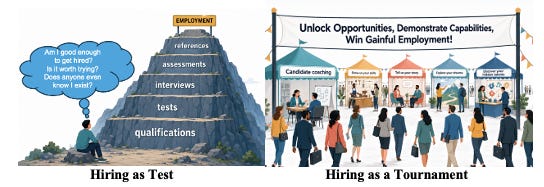
Helping candidates succeed. Hiring can be thought of as two phases. Phase one involves marketing jobs to candidates in order to get people to apply (aka, “filling the funnel”).[1] Phase two focuses on running candidates through a series of exercises designed to identify who should receive job offers. These two phases feel very different from a candidate perspective. Phase 1 treats the candidate as a customer. During this phase the company tries to make itself look like an appealing place to work. Phase 2 treats candidates like questionable merchandise, where they must convince the company they are worthy of being offered a job. This frequently results in application processes that give candidates little sense of agency, support or recognition.
Companies will never hire the people who do not apply. When a person decides to apply for a job their potential value to the organization changes categorically from none at all to some value greater than zero. Hiring processes should be designed with this in mind. This means doing things to ensure candidates know the company values their time and appreciates their interest. Hiring processes should help candidates present the best possible version of themselves provided it is rooted in reality. For example, imagine a job required a specific skill that a candidate possessed but that was not listed on their resume. An effective hiring process would alert the candidate to this missing qualification and give them an opportunity to correct it. Otherwise, the company will lose this person not because they lack the skill, but because they failed to list the skill in their job application.
Evaluating hiring based on successful employees not successful candidates. The term “quality of hire” refers to the value employees provide to a company after they are hired. It is a function of selecting candidates using data that predicts post-hire outcomes such as job performance and retention. What most hiring technology systems actually measure is “quality of candidate”, which is the likelihood that an applicant will pass a company’s selection process. The majority of hiring technology solutions use data to predict people’s potential to be hired into the job. They do not use data to predict whether these people are successful after they are hired.
There is a big difference between being a good candidate and being a good employee. A good candidate is someone who has the skills, social connections and attributes to get hired. A good employee is someone who has the skills, social acumen, and attributes to be successful in the job. These things often overlap, but they are far from the same thing. A socially awkward but technically skilled applicant might come across as a poor candidate in a job interview but be an exceptional employee when placed in the job. Hiring processes should be designed so they are able to identify individuals who may be poor candidates but exceptional employees.
What about candidate fraud?
Creating hiring processes using a hiring tournament model that gives candidates more personal attention, support and agency to ask questions and share information about themselves can also help deter candidate fraud. It is easier fake standardized screening tests than it is to fake conversations, particularly when those conversations can be compared to verifiable, unique job history and personal reference information. The challenge companies face is how to engage candidates in a meaningful, authentic way given limited recruiting resources. This challenge is one of the things that led to the creation of impersonal applicant funnel methods in the first place. What has changed is the ability to augment human conversation with AI enabled communication. The critical point is using AI to amplify human connection between candidates and companies without totally replacing it.
Replacing applicant funnels with hiring tournaments
The use of applicant funnel processes lies at the heart of much of the criticism toward hiring in general. The solution is to stop building processes that focus on company needs over candidate interests, and that emphasize quality of candidate over quality of hire. It is time to eliminate applicant funnels that treat candidates as faceless commodities and replace them with hiring tournaments that support and respect them as unique individuals. This change is within the capabilities of modern technology[2]. It will take effort but will have tremendous benefits for candidates and companies alike. And sticking with the status quo will only become more untenable as time goes on.
[1] Marketing jobs to potential candidates is a critical issue for successful hiring, but it is not the focus of this article.
[2] This was not true before cloud technology and AI data management solutions became widely available.