
Artificial Intelligence vs. Employee Wellbeing
The risks of automating mental tasks

“Work is becoming physically easier but psychologically more difficult” – from the book Talent Tectonics
The field of occupational health arose in the early 20th century in response to changes in work caused by the technology fueling the industrial revolution. Companies that increased employee productivity by automating physical tasks using steam powered machines often created working conditions described as “dark Satanic mills”. Accidental employee death and dismemberment was accepted as a cost of doing business. Regulations focused on ensuring worker safety arose slowly over decades in response to societal pressure placed on companies to protect the health and wellbeing of employees. Modern employees benefit from over 100 years of occupational health research focused on understanding how to perform manual tasks in ways that minimize risks to worker health. But what happens when we start automating mental tasks at a similar scale?
Recent innovations in AI have led to rapid technological automation of mental tasks related to reading and interpreting information, solving complex problems, creating written documents and imagery, monitoring and providing feedback on performance, and developing software applications. Occupational health research historically focused on understanding how technology impacts performance of physical tasks and effects this has on employee wellbeing. We have far less knowledge of the impact technology has on employee wellbeing when it is used to automate and augment performance of mental tasks. Where we are with AI now reminds me of where society was in the early 2000s during the initial days of social media technology. Many of its immediate benefits are clear, but much less is understood about its potential long-term negative impacts.
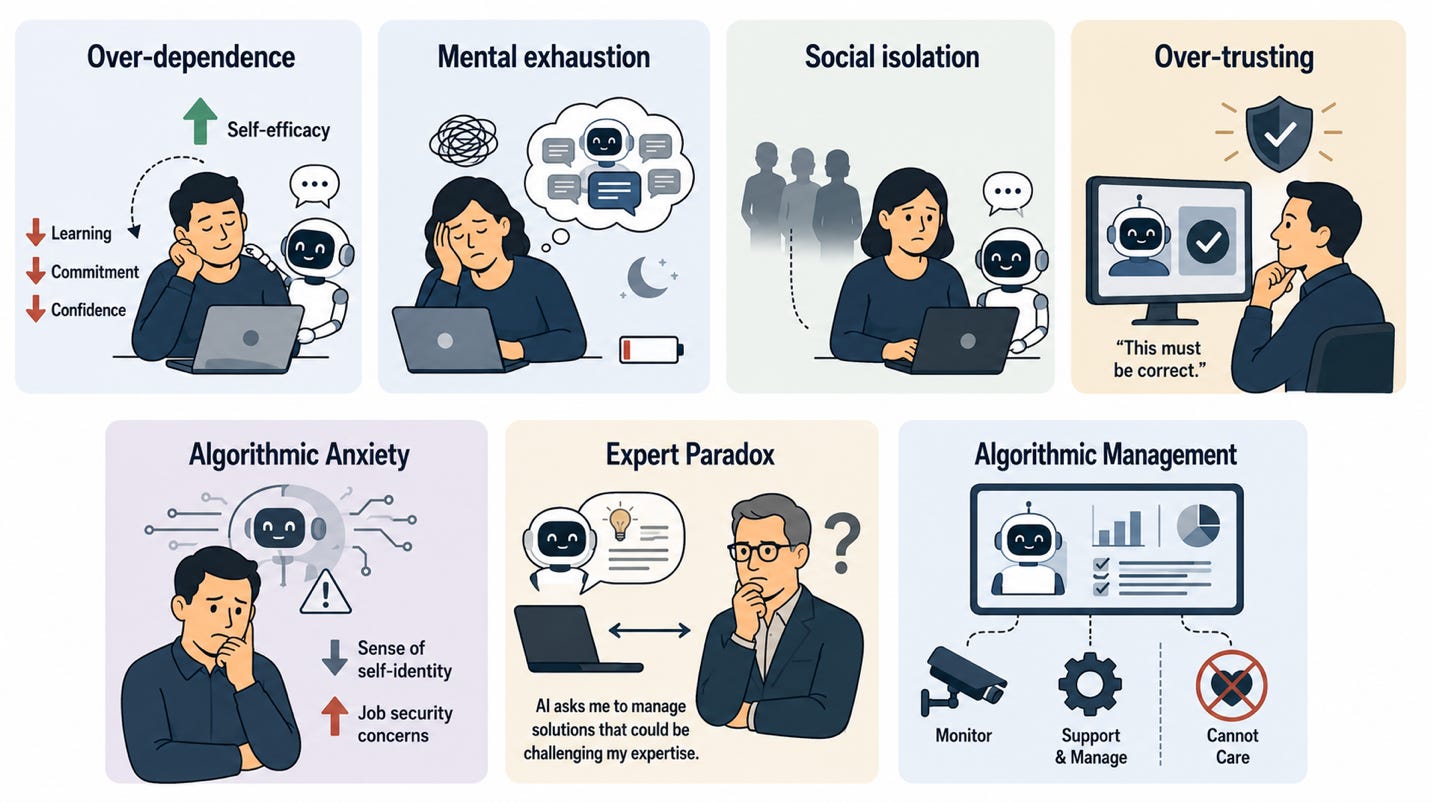
This places us in a tricky situation. Companies must embrace use of AI to redesign work if they are to remain competitive. But because AI is so new, we do not fully understand the risks it may pose to employee wellbeing. Fortunately, some early research is starting to provide insights into what these risks might be and how companies can manage them[1]. The following are thoughts on seven types of risks identified through these studies: co-dependence, social isolation, mental exhaustion, over-trusting, algorithmic anxiety, expert paradox, and algorithmic management. Because this research is in its very early stages, I have added commentary based on my professional experience that occasionally goes beyond what is found in the studies themselves.
Seven AI Wellbeing Risks and how to manage them
1) AI Co-dependence
Having access to AI appears to increase people’s willingness to take on more challenging tasks but it can come at the cost of decreasing their self-confidence toward solving similar tasks on their own without use of AI (Lee et al, 2026; Ren et al, 2026). A key point in this research is the moderating influence associated with how people use AI to solve problems. People who use AI as a form of expert coach appear to be less susceptible to negative effects on their learning and self-confidence. This means taking time to actively engage with AI solutions to understand what they are doing and not relying on AI for every step in the process. People who use AI simply to tell them the answers and do everything for them may get things done faster, but struggle when they are asked to perform the same tasks without AI.
Wellbeing Recommendation: Train and support employees so they use AI in a manner that enhances learning and self-confidence. This means giving them time to engage more deeply with AI solutions as opposed to just using solutions to solve problems as fast as possible. And designing AI solutions to proactively share information and suggest follow on actions to encourage learning. When it is important for employees to truly understand the underlying methods or knowledge used to perform certain tasks, periodically require them to perform those tasks without access to AI tools in a learning environment. For example, when I was a math student we were required to solve certain problems without using calculators because it ensured we understood key concepts underlying the mathematical techniques being taught in the course.
2) AI induced Social Isolation
Asking questions and providing help is an important social mechanism for building relationship among coworkers. AI can weaken social connections among employees by decreasing the need for human-to-human interactions related to collaboration and knowledge sharing (Klimova & Pikhart, 2025). By weakening personal bonds between employees, AI poses risks to employee commitment, support and belonging which play key roles in reducing employee turnover and increasing workforce resilience.
Wellbeing Recommendation. Create cultural norms and events that foster rich human-to-human interaction. This includes physically bringing people together into shared spaces where they actively engage with one another to discuss common work challenges and interest (note, this is not the same as requiring people to commute to an office very day). Also encourage and support employees in creating mentoring and coaching relationships that involve ongoing human-to-human conversations about work challenges and opportunities.
3) Mental Exhaustion
Early research suggests AI can cause excessive rumination and an inability to switch off of work tasks (Bedard et al, 2026). Described as “AI brain fry”, it reflects a sense of cognitive fatigue resulting from a feeling that one can never do enough to keep with up with the pace of change enabled by AI. AI brain fry is similar to mental fatigue issues that have long been associated with software engineering jobs (Sarkar and Parnin, 2017). Mental exhaustion can result in increased mistakes, poorer sleep, and decreased energy levels. As AI enables more people to engage in software development using things such as vibe coding, mental health risks associated with software development appear to be spreading into new types of work.
Wellbeing Recommendation. Expand the use of wellbeing methods associated with software programming to other jobs where employees make extensive use of interactive AI tools to address work tasks. This includes creating policies to protect employees personal time so they do not feel pressured to constantly work, training employees on how to effectively manage work stress, and creating supportive managerial relationships so managers become a resource for support are not just a source of pressure to get more work done faster (Wong et al, 2025)
4) Over-trusting AI
There is evidence that people may trust AI solutions more than their fellow employees when it comes to judging the accuracy and quality of work. This seems more likely to occur people start to anthropomorphize AI solutions, treating them as though they were actual work colleagues (Wiles et al, 2026). This creates tactical risks related to accepting false or misleading guidance from AI solutions. It also poses social risks if people start being treated as less competent and potentially less valuable than the machines they work with. While over-trusting may not be seen as a wellbeing issue, the consequence of over-trusting AI and under-trusting people could impact employee wellbeing in the form of stress caused by social isolation and job insecurity.
Wellbeing Recommendation. Issues of over-trusting AI appear to be more common when companies design and use AI solutions in ways that encourage thinking of them as living creatures. Companies should avoid giving AI solutions human sounding names and human looking avatars, or placing them on org charts so they appear to be an employee. Employees and managers should be reminded that AI solutions can and do make mistakes. And leaders responsible for making talent decisions should be coached so they do not inappropriately compare humans to machines when evaluating job performance.
5) Algorithmic Anxiety
The term “algorithmic anxiety” refers to emotions employees experience when they feel core parts of their work are likely to be automated by technology (Shekhar & Saurombe, 2026). It is associated with a loss of self-identity as being a valuable part of the organization combined with heightened concerns over job security. The result can be decreased organizational commitment, elevated stress levels, and in some cases active resistance toward use of AI solutions.
Wellbeing recommendations. Algorithmic anxiety is rooted in fears that employees’ existing skills will no longer be valuable in a post-AI world. Algorithmic anxiety can be reduced by defining the role employees will play in the organization after AI has been implemented, clarifying how use of AI will change the skills employees need for their jobs, and providing employees with a path to make the transition from pre-AI to post-AI work. This includes communicating how AI is likely to impact the number of jobs in the organization and the expected pay levels associated with different positions.
6) AI Expert Paradox
Somewhat related to algorithmic anxiety, the AI Expert Paradox refers to situations where human experts are responsible for using and monitoring the results of AI solutions that mimic their expertise (Cotton & Scholls-Cotton, 2026). For example, asking an expert contract lawyer to use an AI solution to write legal contracts and then holding them accountable for ensuring the AI generated contracts are well-written. The Expert Paradox creates two issues. One is related to talent management: how can companies build future experts in a world where the tasks used to build the skills of early career experts have been outsourced to machines? The second issue is similar to wellbeing concerns associated with algorithmic anxiety: managing the stress experts can feel when they are asked to use an AI solution that could challenge their credibility and value as experts.
Wellbeing recommendation. Addressing the expert paradox is about showing how expert employees long-term careers will benefit from using AI solutions. Using AI in a way that challenges and builds expert capabilities and not asking experts to use AI systems merely to do things the experts already know how to do. Another issue is figuring out how to equitably resolve issues that may occur when expert employees disagree with AI recommendations and actions.
7) Algorithmic Management
Algorithmic management refers to jobs where employee goals, tasks, and performance are set and evaluated partially or completely by technology solutions (Jarrahi et al., 2023). A common example are drivers for ride-sharing apps who frequently receive trip assignments and performance reviews through an automated system with little to no interaction with human managers or supervisors. AI is expanding use of algorithmic management solutions across a range of jobs including call centers, manufacturing workers, and public safety officers. Algorithmic management poses at least two specific wellbeing risks. First, it can lead to employees being constantly measured which results in heightened sense of anxiety and an inability to take time off to “mentally recharge”. Second, because AI solutions are incapable of actually caring about another human, use of algorithmic management can increase feelings of social isolation.
Wellbeing recommendation. Companies using algorithmic management techniques can protect employee wellbeing by creating breaks when employee behavior is not being actively recorded. These breaks play a key role in letting employees temporarily switch off from working and mentally recharge. It is also important to ensure employees have a way to contact a supportive human when their work issues go beyond what can be effectively addressed by an uncaring algorithm. No person should ever feel like they are working for a machine.
It is not about if we use AI, it is about how we use AI
We are in the early stages of understanding how AI will impact employee wellbeing. The examples here are a starting point that will evolve as we gain more experience insight into AI’s impact on work. It is also important to remember AI can significantly improve employee wellbeing when used in ways that give employees a greater sense of control over their work and careers. Examples include giving employees more control over setting work schedules, building job skills, and monitoring health patterns.
Perhaps the most critical thing we can do at this point of the AI journey is increase leadership awareness of potential wellbeing issues we need to manage. This is not about slowing down the use of AI. It is about increasing use of AI in ways that recognize and positively shape the inevitable impact it will have on employee mental wellbeing.
References
American Psychological Association. (2023). 2023 Work in America™ survey: Artificial intelligence, monitoring technology, and psychological well-being. https://www.apa.org/pubs/reports/work-in-america/2023-work-america-ai-monitoring
Bedard, J., Kropp, M., Hsu, M., Karaman, O. T., Hawes, J., & Rosen Kellerman, G. (2026). When using AI leads to “brain fry”: Certain patterns of AI use drive cognitive fatigue, while others reduce burnout. Harvard Business Review. (Verify final publication details when available.)
Cotton, S., & Scholls-Cotton, L. (2016). The AI expertise paradox. Issues in Science and Technology, 32(4), 55–61. (Verify page numbers.)
Jarrahi, M. H., Möhlmann, M., & Lee, M. K. (2023). Algorithmic management: The role of AI in managing workforces. MIT Sloan Management Review. https://pages.ischool.utexas.edu/hai-files/files/publications/72/2023-algorithmic_management_the_role_of_ai_in_managing_workforces.pdf
Klimova, B., & Pikhart, M. (2025). Exploring the effects of artificial intelligence on student and academic well-being in higher education: A mini-review. Frontiers in Psychology, 16, 1498132.
Lee, E. H., Yin, Y., Jia, N., & Wakslak, C. J. (2026). Relying on AI at work reduces self-efficacy, ownership, and meaning while active collaboration mitigates the effects. Scientific Reports, 16, Article 13583.
Ren, L., Stephens, J. M., & Lee, K. (2026). The impact of AI on learners’ self-efficacy: A meta-analysis. Behavioral Sciences, 16(1), 158. https://doi.org/10.3390/bs16010158
Sarkar, S., & Parnin, C. (2017). Characterizing and predicting mental fatigue during programming tasks. In Proceedings of the 2nd International Workshop on Emotion Awareness in Software Engineering (SEmotion ‘17) (pp. 32–37). Association for Computing Machinery. https://doi.org/10.1109/SEmotion.2017.5
Shekhar, A., & Saurombe, M. D. (2026). Algorithmic anxiety: AI, work, and the evolving psychological contract in digital discourse. Frontiers in Psychology. (Verify volume, article number, and DOI.)
Wiles, E., Hsu, M., Bedard, J., & Kropp, M. (2026). Putting AI on the org chart: Evidence on delegation and oversight. Boston University & Boston Consulting Group Working Paper. https://www.emmawiles.com/storage/ai_employee.pdf
Wong, N., Jackson, V. F., van der Hoek, A., Ahmed, I., Schueller, S. M., & Reddy, M. C. (2023). Mental wellbeing at work: Perspectives of software engineers. In Proceedings of the 2023 CHI Conference on Human Factors in Computing Systems (Article 713). Association for Computing Machinery. https://doi.org/10.1145/3544548.3581180